Google Ads
Google Ads led to landing pages.
About Muhammad Ali Abbasi
I work in performance marketing, but the part that interests me most has never been the ad itself.
It is what happens next.Does the person understand the offer?
Does the landing page answer what they came looking for?
Does the enquiry become a real conversation?
Can the business tell which marketing actually created the opportunity?
Those questions have shaped the way I work far more than any advertising platform.
Based in Dubai, UAE. Working across paid media, conversion and marketing strategy.

The part that changed everything
I started noticing this more and more.
A campaign could show good numbers.
Clicks were coming in.
The cost per lead looked reasonable.
The report looked clean.
Then you spoke to the business.
“Most of these leads are not serious.”
“We are getting enquiries, but nobody is booking.”
“Google says we have conversions. We cannot see them.”
“We spent more this month. Sales did not move.”
That gap changed the way I looked at marketing.
Because once you hear the person actually dealing with the leads, the dashboard stops being the whole story.

You start asking better questions.
What happened before the click?
What happened after it?
Where did the customer hesitate?
What did sales see that marketing did not?
And which number actually matters to this business?
That is where I stopped thinking about campaigns as isolated campaigns.How my work evolved
Sometimes the problem was inside Google Ads.
A keyword was too broad.
The intent was wrong.
The campaign structure was pulling in people the business never wanted.
Sometimes the advertising was fine.
The landing page was the weak point.
Sometimes the page worked, but the tracking did not.
Sometimes the leads were real, but the qualification process made good opportunities look bad.
And sometimes the business was simply using the wrong channel for the way its customers buy.
Following those problems naturally pulled my work beyond media buying.

Google Ads led to landing pages.
Landing pages led to conversion.
Conversion led to tracking.
Tracking led to lead quality.
Lead quality led back to the business.
That is why I now think about performance marketing as a connected customer acquisition system.
My work today
My work now sits across several parts of the acquisition journey.
I look at where demand exists, how the audience behaves and what each channel is actually expected to do.
The page needs to continue the conversation, answer the next question and make the next action feel clear.
That includes areas such as Google Analytics 4, Google Tag Manager and advertising-platform conversion tracking.
The quality of that enquiry, what happens next and whether it becomes business are part of the performance conversation too.
Who are we trying to reach? What are we asking them to buy? Why should they care? Where should we reach them? What should happen after they respond?
Industry experience
A patient can search with strong intent and still need reassurance before taking the next step. The clinic, doctor, treatment information, location, page experience and follow-up can all influence whether that search becomes an appointment.
The person clicking may not be the person signing. A distributor, procurement manager, clinic or decision-maker can take much longer to move from first contact to commercial discussion. That changes what should be measured.
A business does not need fifty enquiries simply because fifty looks better than twenty. It needs enough of the right enquiries to create profitable work.
On platforms such as Meta, TikTok and Snapchat, the creative often starts the buying journey rather than appearing at the end of it.
Different industries create different problems.
That is why I prefer understanding the buying journey before choosing the marketing playbook.
Explore IndustriesHow I think
More traffic is not always the answer. More leads are not always the answer. Start with the business problem.
Search behaviour, trust, price, urgency, competition and buying cycle change what good marketing looks like.
The weak point may be the ad. It may also be the offer, page, form, tracking, qualification or follow-up.
A platform metric becomes more useful when we understand what happens after it.
A test that does not win can still be valuable if it tells us what to change next.
That is the part of performance marketing I enjoy most.
Turning activity into something we can understand and improve.Working style
I like knowing why we are doing something before we spend money doing it.
That means understanding the business first.
Looking at the customer.
Researching the market.
Checking what the existing data is telling us.
Then deciding what deserves attention.
Marketing exists to support something outside the marketing department.
Google, Meta, TikTok and Snapchat solve different problems.
A conversion should mean something to the business.
A client should understand what is happening without needing to become a media buyer.
Good strategy should survive contact with real data.
Experience
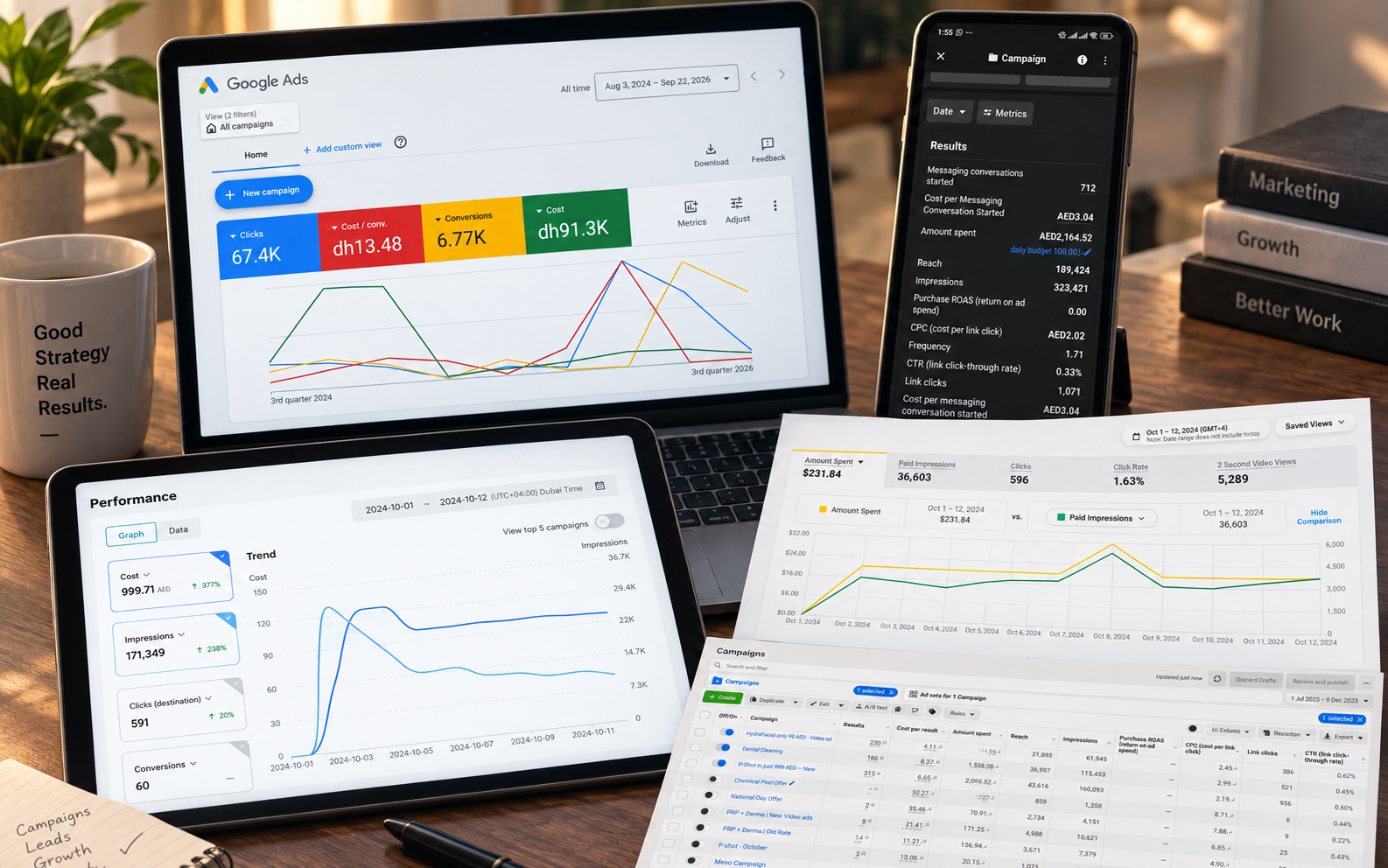
The useful lessons rarely came from campaigns where everything worked immediately.
They came from accounts where leads were expensive.
Pages where people dropped off.
Tracking that did not match reality.
Campaigns where the obvious answer was not the correct one.
Industries where customers behaved differently from what the standard playbook suggested.
That is the work I want this website to document.
My case studies will show the actual business situation, what I found, what changed and what happened next.
Where verified numbers and client permission are available, I will show them.
Where the client needs privacy, the commercial problem and learning can still be shared without exposing confidential information.
Where I work from
I am based in Dubai and much of my practical experience has been shaped by businesses operating in the UAE.
That market has taught me a lot.
Different nationalities.
Different customer behaviours.
High competition.
Arabic and English audiences.
Businesses selling locally while thinking regionally.
Companies using WhatsApp as part of the sales journey.
International brands entering GCC markets.

But the work itself travels.
A customer in London still needs a reason to choose.
A business in the US still needs to know where its acquisition cost comes from.
A company in Saudi Arabia still needs marketing that fits the way its market buys.
The tools may be global.
The strategy still has to understand the market.
Dubai is where I work from.It is not where my thinking stops.
MuhammadAliAbbasi.com
There is already enough marketing content telling people to improve their targeting, write stronger hooks and test more creatives.
I want to go deeper.
What happens when the cheaper lead is actually worse?
When should a service business use Google instead of Meta?
Why does a landing page work for one type of traffic and fail for another?
What does a clinic need to measure after the form submission?
Where does attribution stop being useful?
How do you know whether the problem is traffic, conversion or sales?
Those are the kinds of questions I want to document here.
Through case studies.
Experiments.
Campaign observations.
Things that worked.
Things that did not.
And the thinking behind the decision.
At a glance
Performance Marketing Consultant
Dubai, United Arab Emirates
Performance Marketing · Google Ads · Meta Ads · TikTok Ads · Snapchat Ads · Lead Generation · Landing Pages & CRO · Conversion Tracking · Marketing Strategy
Healthcare · Medical Clinics · Medical Devices · B2B · Service Businesses
UAE · GCC · International
Work with me
You do not need to arrive with the diagnosis.
Maybe acquisition is getting too expensive.
Maybe lead quality has dropped.
Maybe you are unsure which channel deserves the next part of the budget.
Maybe the campaigns look healthy and the business still feels stuck.
Tell me what you are seeing.
We can work from the problem backwards.
Start with the situation. We can figure out the rest from there.